
CONGRATULATIONS SPONSOR KURITA WATER AND ENVIRONMENT FOUNDATION (KWEF) II
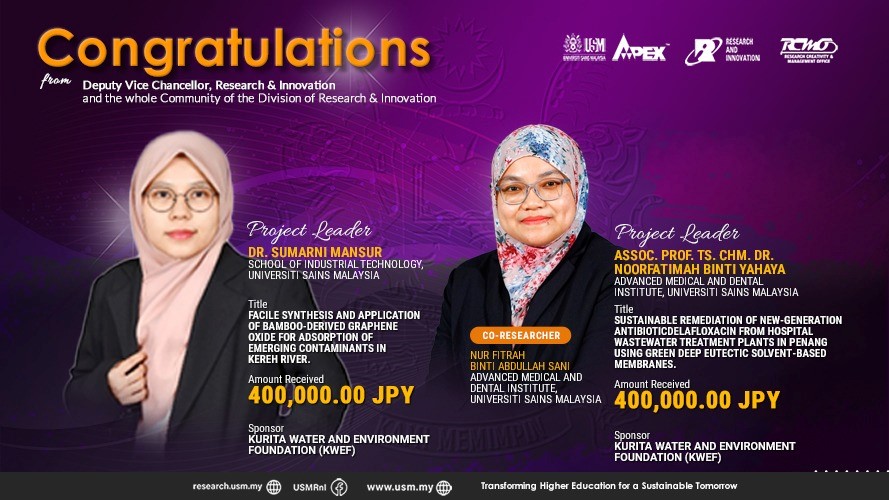 DR. SUMARNI MANSUR
The presence of emerging contaminants (EC) such as pharmaceuticals and industrial chemicals in water bodies poses significant environmental and public health concerns. ECs enter the aquatic environment through different routes, including direct discharge of treated or raw wastewater from municipal, industrial wastewater treatment plants, hospitals, landfill leachate, and surface runoff from agricultural or urban areas where treated wastewater is applied for irrigation activities. Kereh River, one of the most polluted rivers in Penang, Malaysia has shown increasing levels of such contaminants, largely due to untreated swine wastewater, domestic discharge, and industrial discharge. These pollutants contribute to oxygen depletion, algal blooms, and aquatic ecosystem degradation when released untreated into rivers. Of even greater concern is the presence of veterinary antibiotics and endocrine-disrupting compounds, commonly found in pig urine and faeces, which can enter the water system and contribute to antibiotic resistance and toxic effects on aquatic life. This project proposes to develop bamboo-derived graphene oxide (BGO) as an innovative solution to capture and remove EC from the Pinang River, offering a dual benefit of pollution control and biomass valorization. BGO synthesized via a facile and environmentally friendly method, exhibits high adsorption efficiency for emerging contaminants including antibiotics, nutrients, and organic matter that are present in wastewater, and can effectively reduce their concentration in polluted surface water in the Kereh River. Bamboo biomass will be collected, dried, and pyrolyzed to produce biochar, which will then be oxidized using a modified Hummers’ method to synthesize bamboo-derived graphene oxide (BGO). Batch adsorption experiments and water samples from the Kereh River will be used to assess BGO’s real-world performance. This project supports SDG 6 by developing sustainable wastewater treatment using BGO. It promotes circular economy through biomass valorization and offers an innovative solution for emerging pollutant removal.
ASSOC. PROF. TS. CHM.DR. NOORFATIMAH BINTI YAHAYA
The growing use of fourth-generation antibiotics such as delafloxacin has raised significant environmental concerns due to their persistence in aquatic environments, especially in hospital wastewater. Delafloxacin, commonly used to treat skin and respiratory infections, is highly stable and resistant to degradation, posing risks to aquatic ecosystems even at trace levels. In Penang, Malaysia, the increasing pharmaceutical runoff highlights the urgent need for effective remediation strategies aligned with Malaysia’s National Water Quality Standards (NWQS). Despite its medical relevance, targeted environmental studies on delafloxacin remain limited, presenting a critical research gap. This study aims to develop a green, biodegradable membrane system for the selective removal of delafloxacin from hospital wastewater using a novel blend of polylactic acid/poly(butylene adipate-co-terephthalate) (PLA/PBAT) incorporated with a hydrophobic deep eutectic solvent (DES). The membrane is fabricated by dissolving PLA and PBAT (80:20 wt%) in dichloromethane, adding a thymol-based DES (10–20 wt%), homogenizing, and casting the solution for solvent evaporation. The resulting membranes will be characterized for morphology (SEM), hydrophobicity (contact angle), and mechanical strength (tensile testing). Removal studies will be conducted by immersing the membranes in delafloxacin-spiked hospital wastewater under optimized conditions, with quantification via HPLC-UV. This work leverages recent advancements in DES-based membranes, which offer enhanced selectivity and environmental compatibility. The use of PLA/PBAT ensures biodegradability and mechanical flexibility, while DES enhances membrane performance. By addressing a critical gap in the remediation of emerging pharmaceutical pollutants, this study contributes to the development of sustainable water treatment technologies. The findings are expected to support broader applications for removing diverse environmental contaminants and strengthen regulatory strategies for pharmaceutical pollution control in Malaysia.
- Hits: 222